Top 5 tips for multi drop delivery route planning

Table of Contents
If you’re managing a delivery fleet, multi-drop delivery route planning is probably one of the most demanding parts of your working day. Vehicles need loading in the right order. Drivers need realistic schedules. Customers expect a delivery window you can actually hit, and they’ll notice when you don’t.
The margin for error is slim, and the consequences of getting it wrong are immediate: late deliveries, wasted fuel, frustrated drivers, and customers who won’t give you a second chance.
The good news? Smarter planning – supported by the right tools – can transform the whole operation. Whether you’re still planning routes manually or looking to get more from your existing software, these five tips will help you deliver more, spend less, and keep customers coming back.
What is multi drop delivery route planning?
Multi drop delivery route planning is the process of sequencing and optimising routes for vehicles that need to make multiple deliveries across different locations in a single shift. Unlike point-to-point logistics, multi drop operations have to balance competing variables simultaneously: driver hours, vehicle capacity, customer time windows, traffic conditions, and fuel costs.
Done manually, it’s time-consuming and error-prone. Done with purpose-built route planning software, it becomes a competitive advantage.
Why does it matter more than ever?
Customer expectations have shifted significantly. Last-mile delivery now accounts for over 53% of total shipping costs, making efficient route planning one of the most important levers for controlling operational spend. At the same time, driver shortages, fuel price volatility, and tighter delivery windows mean there’s less room to absorb inefficiency than there was even five years ago.
For fleet operators, the question is no longer whether to invest in better multi drop delivery route planning. It’s how to do it well.
Tip 1: Prioritise urgent deliveries and load accordingly

Let’s start with the basics; you need to make sure your driver can get their hands on the right goods quickly once they reach their destination. Mistakes are often made at the very start of the route planning process: vehicles are loaded inefficiently, parcels are stacked out of drop sequence, or sometimes the wrong van or lorry is used for the job entirely.
Making sure parcels are accessible and loaded in the right order means drivers aren’t wasting time at each stop rifling through the load to find the right package. Multiply that by 20 or 30 drops a day, and you’re losing a significant amount of productive time that could be spent completing more deliveries.
Leading route planning software not only lets you plan your routes, it also recommends the right vehicle for each job based on the space you need for the packages you’re carrying, removing the guesswork from load planning entirely.
Pro tip: Common mistake to avoid Don’t load vehicles by package size alone. A large item that needs to be delivered last should go in first, not wedged in wherever it fits. Loading in reverse drop order is one of the simplest operational changes a depot can make, and one of the most impactful. If your team is still loading to convenience rather than sequence, that’s where to start.
Tip 2: Have all the right information to hand before you plan

Before a single route is built, make sure you have all the information about your drops in one place. Missing or incomplete delivery data – wrong addresses, unconfirmed time windows, unknown site access requirements – creates problems that no amount of optimisation can solve downstream.
Route optimisation software like MaxOptra allows you to input delivery information on screen quickly and accurately, and integrates with your existing order management system to pull data automatically. Routes are then planned based on the most efficient travel times, factoring in all the constraints you’ve defined.
It means your drivers don’t need to keep referencing their destinations or reworking their own drop schedule on the road. Leading route optimisation solutions also keep you in constant contact with drivers through a mobile app they can download on their phone, giving the transport office real-time visibility of delivery and call status throughout the day.
Pro tip: Go further with centralised data Before your planning session, confirm that your customer records are accurate and up to date. Outdated addresses, lapsed time window agreements, and missing contact numbers are among the most common causes of failed first-time deliveries. A short weekly data hygiene check can prevent a disproportionate number of avoidable problems. MaxOptra’s CRM integration capabilities make it straightforward to keep delivery data synced with your wider systems. Alternatively, you can book in health checks for support in your data cleaning.
Tip 3: Plan routes automatically

Take the hassle out of route planning by using route optimisation software to do the hard work for you. Once the details of your deliveries are loaded, the route planner does the rest; dynamically planning the fastest and most efficient routes according to which drops you need to make.
Good delivery planning software takes everything into account: customers’ time windows, vehicle capacities, driver breaks, working hours, and any required skills needed to make drops efficiently and compliantly. All you need to do is define the resources and hit plan.
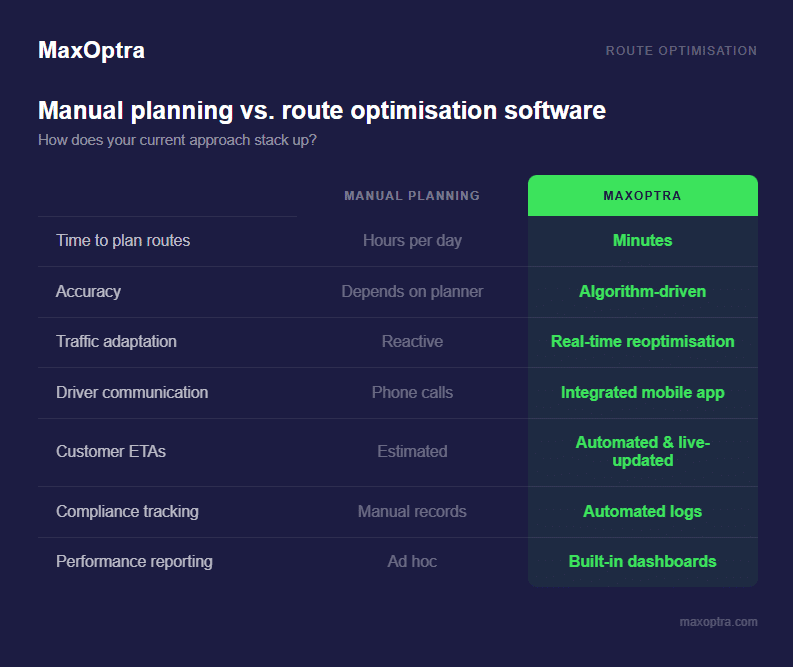
For transport planners who currently spend hours each morning building routes manually, automation isn’t just a time-saver. It’s a fundamental shift in how operations run, and it produces consistently better results than even the most experienced planner working by hand.
Pro tip: Match the right vehicle to every drop Not every delivery can go on every vehicle. Some drops require specific vehicle types or size restrictions that rule out certain loads. Configuring your vehicle attributes within MaxOptra means the system automatically accounts for these requirements during optimisation; matching the right vehicle to the right job from the outset, and eliminating a whole category of last-minute problems before they happen.
Tip 4: Manage change on the go
Traffic, weather, refused deliveries, last-minute orders; things change, and they rarely change at a convenient moment. The fleets that handle disruption best aren’t the ones with the most rigid plans. They’re the ones with the most flexible systems.
Good multi drop route planning software gives transport managers real-time visibility of every vehicle, so they can see exactly where drivers are, how they’re tracking against schedule, and where capacity exists to absorb an urgent job. The office can add or remove stops from a driver’s schedule remotely without impacting the rest of the run.
When a driver is on the road, solutions like MaxOptra works out the progress on each run, the current position, the remaining work, and the available driving hours. You can then use that information to spot gaps and find the best option to fit in a last-minute order, without disrupting other customers’ windows.
Pro tip: Build a contingency buffer into high-priority runs For your most time-critical deliveries, consider building a small buffer into the planned schedule. A 10-minute contingency on a high-value customer’s window can absorb minor delays without triggering a missed delivery. Route optimisation software makes this easy to configure, and means you’re not relying on everything going perfectly to meet your commitments.
Tip 5: Be realistic about delivery time

Giving customers realistic delivery windows sets expectations correctly and reduces stress across the whole operation; in the transport office, behind the wheel, and at the customer’s door. Overpromising on delivery times doesn’t win loyalty. Consistently hitting the window you gave does.
A multi drop route planner plans routes using real-time traffic data, making sure the delivery window given to the customer is one you can actually meet. It then automatically sends advanced email and SMS ETA notifications to keep customers informed of when to expect their delivery based on the driver’s live progress.
This kind of proactive communication reduces inbound calls to the transport office, improves customer satisfaction, and means fewer complaints land on your desk at the end of the day. Tools like this mean you can deliver great customer service alongside the package itself.
Pro tip: Use delivery data to refine your time windows over time Leading route planning software captures performance data on every run; actual vs. planned time per stop, on-time delivery rates, and where delays consistently occur. Review this data regularly. If a particular customer consistently takes longer to service than planned, update their allocated service time. If a route regularly runs long on a Friday afternoon, factor that into future planning. Marginal improvements compound quickly across a high-volume operation. MaxOptra’s reporting dashboards make it straightforward to spot these patterns and act on them.
Manual planning vs. route optimisation software: a quick comparison
See what better route planning looks like in practice
These five tips – and the pro advice within them – will help you plan all your delivery routes more effectively. And just remember: you don’t need to do all the hard work yourself when there’s route optimisation software built specifically to do it for you.
MaxOptra helps transport teams plan smarter routes, keep drivers informed, and give customers the visibility they expect, all from a single platform.
Book your MaxOptra demo and see how much time, cost, and stress you could save starting from day one.
Related reading:
- Enhancing Last-Mile Delivery with Route Optimisation Software
- How Route Optimisation Helps to Satisfy Same and Next-Day Delivery Demand
- Cost Per Mile: What It Is and Why Every Fleet Manager Should Track It
Multi drop delivery route planning FAQ
What is multi drop delivery route planning?
Multi drop delivery route planning is the process of creating optimised routes for vehicles that need to make multiple deliveries or service calls across different locations in a single shift. It involves balancing variables like customer time windows, vehicle capacity, driver working hours, and traffic conditions to find the most efficient sequence of stops.
What’s the difference between a route planner and route optimisation software?
A basic route planner maps a sequence of stops. Route optimisation software goes much further; it automatically calculates the most efficient sequence based on dozens of real-world constraints, updates dynamically when conditions change, integrates with driver apps and customer communications, and generates performance reporting. For multi drop operations at any meaningful scale, the difference in outcomes is significant.
How does route optimisation software handle last-minute changes?
Purpose-built platforms like MaxOptra give transport managers real-time visibility of all vehicles and allow stops to be added, removed, or rescheduled remotely. The system automatically recalculates the affected routes and updates driver schedules via the mobile app, without disrupting other deliveries on the run.
Can route planning software help with driver hours compliance?
Yes. MaxOptra factors in driver working hours, mandatory break requirements, and available driving time as part of the optimisation process. This helps ensure routes are legal and compliant from the point of planning, rather than relying on drivers or managers to monitor this manually during the day.
How long does it take to plan routes with MaxOptra?
What might take an experienced transport planner several hours to plan manually can typically be optimised in minutes with MaxOptra; often with better outcomes in terms of efficiency, time window compliance, and cost. The time saving compounds across every working day.
Is route optimisation software suitable for smaller fleets?
Yes. While the efficiency gains scale with fleet size, smaller operations benefit too, particularly in terms of planning time saved, reduction in failed deliveries, and the ability to offer customers accurate ETAs. MaxOptra is used by fleets ranging from a handful of vehicles to operations running dozens of routes simultaneously.
Maxoptra System
© MaxOptra, 2023. Privacy Policy and Cookies