The Environmental Benefits of Route Optimisation

Table of Contents
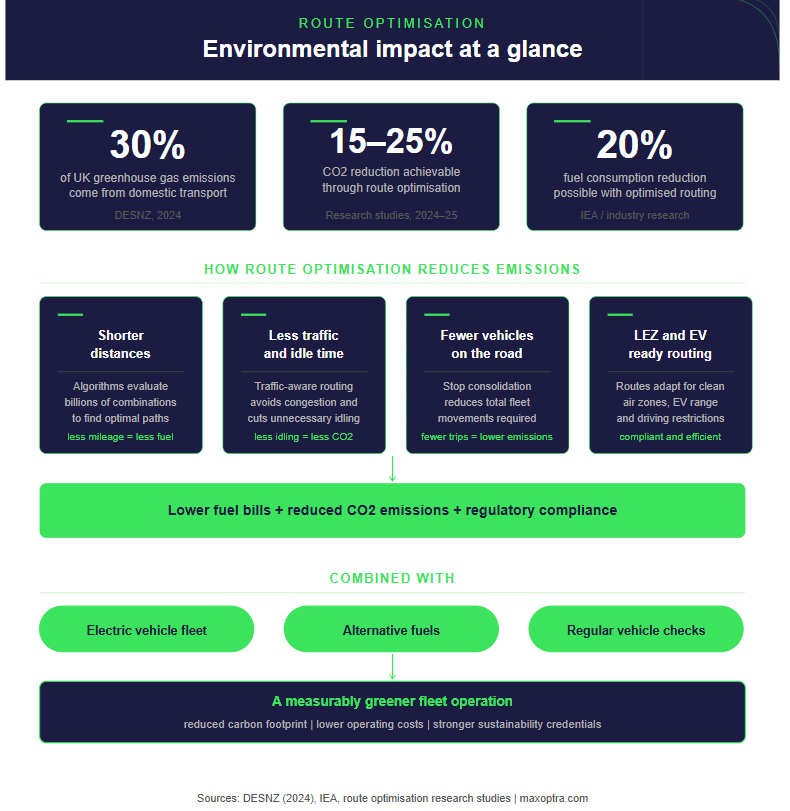
Transport is now the UK’s single largest source of greenhouse gas emissions, accounting for 30% of total domestic output in 2024. For businesses running delivery or field service fleets, that statistic carries real weight, and growing pressure from regulators, customers, and investors to act on it.
Route optimisation has emerged as one of the most practical and immediately impactful tools available to logistics and fleet operations. It does not require an overnight switch to electric vehicles or a complete overhaul of your supply chain. It works with your existing fleet, your existing infrastructure, and produces measurable results from day one.
In this post, we look at exactly what those results are, why the environmental benefits of route optimisation are better documented than ever, and how to embed it effectively in your operation.
The environmental impact of traditional route planning
For many businesses, route planning still relies on manual processes; a planner working from experience, a basic mapping tool, or a spreadsheet. These approaches are not inherently bad, but they cannot account for the sheer complexity of optimising dozens or hundreds of stops across a changing road network.
The result is predictable: vehicles travel further than necessary, idle in traffic longer than they need to, and return with gaps in their load that could have been consolidated. Each of these inefficiencies translates directly into fuel burn and CO2 output.
Road vehicles account for around 90% of domestic transport emissions in the UK, with heavy goods vehicles among the largest contributors. While the total figure has decreased compared to pre-pandemic levels, domestic transport emissions have fallen by only around 13% since 1990; a rate far slower than other sectors, where reductions of 50-70% have been achieved over the same period. The logistics sector has significant ground to make up.
The environmental benefits of route optimisation: how emissions are reduced
Route optimisation software uses advanced algorithms to calculate the most efficient sequence and path for a fleet’s daily work. The environmental gains come from several interconnected mechanisms.
Shorter total distances travelled
The most direct impact is mileage reduction. Modern route optimisation engines evaluate billions of possible combinations to identify routes that genuinely minimise distance; not just the obvious A-to-B path, but the full multi-stop sequence across an entire fleet. Industry research consistently shows this can reduce fuel consumption by up to 20%, with corresponding reductions in CO2 output.
For a business running ten vehicles covering 150 miles each per day, even a 10% reduction in distance travelled represents significant fuel and emissions savings annually.
Less time spent in traffic
Idle vehicles in traffic are a particularly wasteful source of emissions: the engine runs, fuel burns, and nothing moves. Traffic congestion costs the European economy an estimated €100 billion every year in lost time and excess fuel – more than 1% of EU GDP – making avoidable delays one of the most significant drains on logistics efficiency.
Route optimisation software that incorporates historical traffic patterns and real-time data can route vehicles around predictable congestion, reducing idle time substantially. This is especially valuable in urban areas where last-mile delivery can otherwise account for a disproportionate share of a route’s total emissions.
Fewer vehicles on the road
By consolidating stops intelligently and matching vehicle capacity to demand, route optimisation can reduce the number of vehicles required for a given workload. Fewer journeys means fewer total emissions, less wear on vehicles, and a smaller operational footprint overall.
Adaptability for low emission zones and electric vehicle fleets
The UK has seen rapid expansion of Clean Air Zones and Low Emission Zones (LEZs), with restrictions already in place or planned in cities including London, Birmingham, and Bristol. Route optimisation software can factor these zones directly into planning, ensuring vehicles with the wrong emissions rating are not routed into restricted areas; avoiding fines and maintaining compliance without manual intervention.
The broader benefits of eco-friendly logistics

The environmental benefits of route optimisation are compelling on their own terms. But it is worth understanding that sustainability and commercial performance are not in tension here – they reinforce each other.
Reduced fuel costs
Fuel is one of the largest controllable costs in any logistics operation. A 15-20% reduction in fuel consumption, achievable through route optimisation alone, has a direct and material impact on the bottom line. For a fleet spending £200,000 per year on fuel, that is a saving of £30,000 to £40,000 annually, without any capital investment in new vehicles.
Meeting customer expectations around sustainability
Consumer and B2B buyer expectations around environmental responsibility have shifted substantially. Research from the Logistics Hall of Fame found that 75% of logistics companies have already invested in sustainability-related areas, with around half rating climate-related financial risk as medium to high. Businesses that can demonstrate measurable reductions in fleet emissions are increasingly well-positioned to win and retain customers who factor supplier sustainability into procurement decisions.
Reporting and accountability
With sustainability reporting requirements expanding – including the UK’s mandatory Streamlined Energy and Carbon Reporting (SECR) framework for larger businesses – having data on fleet emissions is becoming a compliance necessity, not just a nice-to-have. Route optimisation platforms generate the reporting data needed to track performance over time, identify high-emission outliers, and demonstrate progress to stakeholders.
You can read more about why sustainable logistics matters right now and how customer expectations are shaping the sector.
Additional sustainable fleet practices
Route optimisation sits at the centre of any sustainable fleet strategy, but it works best alongside a broader set of operational improvements.
Electric and alternative fuel vehicles
The transition to electric vehicles is accelerating across UK fleets. EVs eliminate tailpipe emissions entirely, and when charged from a renewable energy source, represent a near-zero-emission option for last-mile and urban delivery. The business case for EVs has strengthened considerably as charging infrastructure has improved and total cost of ownership figures have become more competitive.
For businesses not yet ready to commit to full electrification, alternative fuels including hydrotreated vegetable oil (HVO), biodiesel, and compressed natural gas offer meaningful reductions in CO2 and particulate emissions compared to standard diesel, while working with existing vehicle platforms.
MaxOptra’s route planning tools are built to handle electric vehicles alongside conventional fleet, accounting for range, charging stops, and load considerations in a single unified plan.
Regular vehicle maintenance and daily checks
A poorly maintained vehicle burns more fuel and produces higher emissions than a well-maintained one. Under-inflated tyres, dirty air filters, and engine faults all degrade fuel efficiency measurably. Routine vehicle maintenance is therefore not just a safety and compliance issue; it is a direct contributor to environmental performance.
Daily digital vehicle checks make it straightforward for drivers to flag issues before they escalate, keeping the fleet operating at its most efficient and supporting a continuous improvement culture around environmental performance.
Driver behaviour and training
The same vehicle, on the same route, can produce meaningfully different emissions depending on how it is driven. Smooth acceleration, appropriate speed, and avoiding unnecessary idling are all behaviours that reduce fuel consumption. Training drivers on eco-friendly techniques – and using telematics data to monitor and reinforce good habits – compounds the gains from route optimisation with further efficiencies at the individual vehicle level.
How to implement environmentally friendly routing

Getting started with route optimisation does not need to be a complex project. The following steps provide a practical framework.
Establish a baseline
Before making changes, gather data on your current performance: total miles driven, fuel consumption by vehicle, average journey times, and any existing emissions data. This baseline is essential for measuring the impact of improvements and for sustainability reporting purposes.
If you have not previously tracked this data systematically, your route optimisation provider can often help you identify what to collect and how to structure it.
Deploy a route optimisation solution with sustainability at its core
Not all routing tools are created equal. Look for a platform that optimises for multiple variables simultaneously – distance, time, vehicle capacity, driver hours – and that can incorporate constraints like ULEZ boundaries, and customer time windows. The ability to run scenario comparisons is also valuable: being able to model the environmental impact of adding a vehicle to the fleet, or switching a particular route to an EV, supports better strategic decisions.
MaxOptra’s route optimisation software is designed to address exactly these challenges, with a reporting suite that makes tracking environmental performance straightforward.
Build a culture of sustainability within your team
Technology alone does not change behaviour. The most effective implementations combine the right software with clear communication to drivers and operations staff about why sustainability matters and how their actions contribute to it. Use the training and onboarding resources your provider offers, set visible targets, and share progress regularly.
Our implementation and support team works closely with customers to embed route optimisation into day-to-day operations in a way that sticks.
Monitor, report, and iterate
The logistics landscape changes constantly: new customers, new routes, new regulations, new vehicle types. Route optimisation is not a set-and-forget solution. Establish a regular review cadence, use your platform’s reporting and analysis tools to identify opportunities, and stay informed about developments in regulation and technology that may affect your approach.
Explore our guide on 5 ways delivery operations can reduce their fuel consumption for further practical ideas.
The road ahead: sustainability in transport
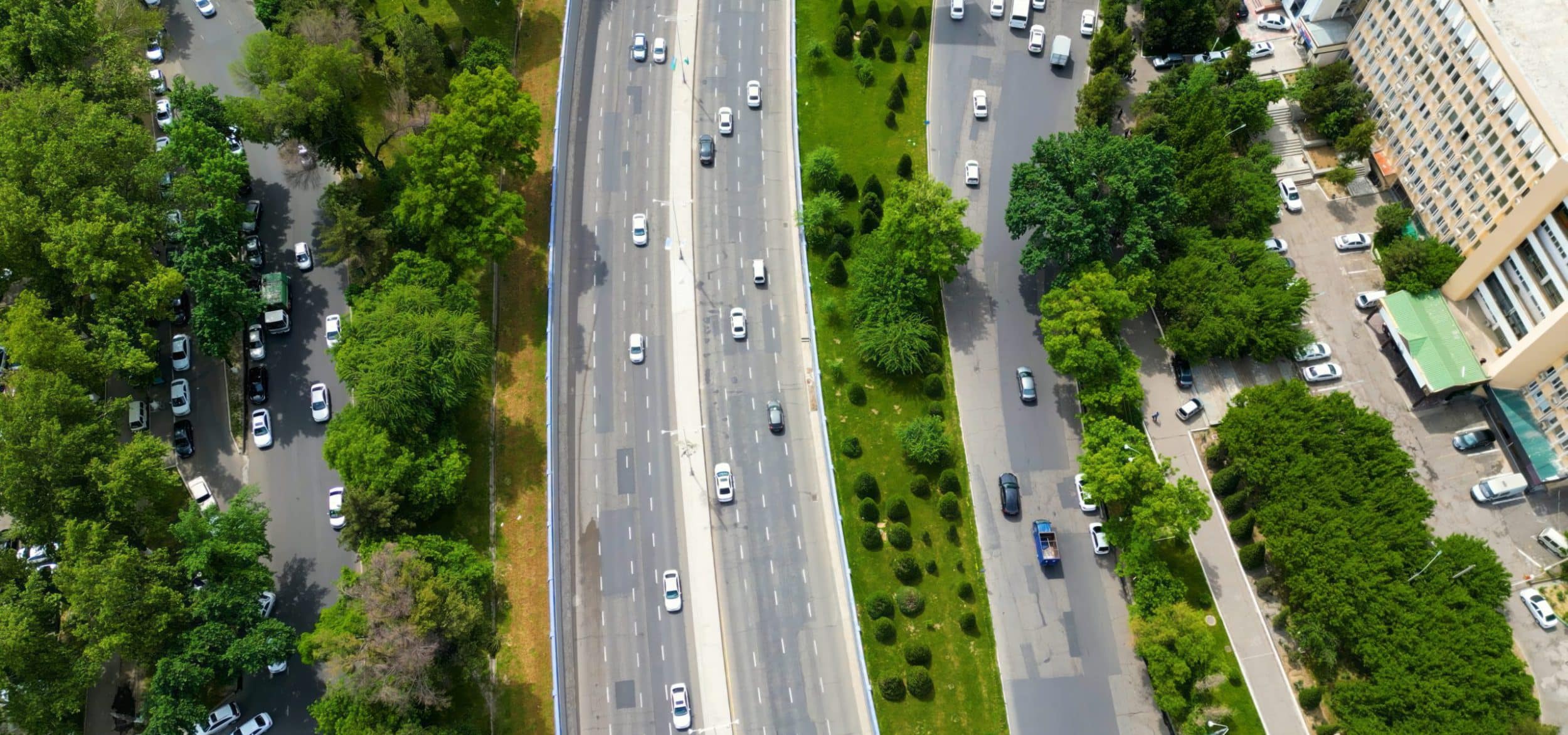
The trajectory for sustainability in UK logistics is clear. Regulatory pressure will increase, with Clean Air Zone coverage expanding and emissions reporting obligations broadening to cover more businesses. Customer expectations will continue to rise. And the commercial case for efficient, lower-emission operations will only strengthen as fuel costs remain volatile and technology costs fall.
The businesses best placed to navigate this environment are those that treat sustainability not as a separate initiative but as a natural consequence of running a well-optimised operation. The environmental benefits of route optimisation make it the most accessible and highest-impact tool available to most fleets today; delivering environmental improvements and commercial savings simultaneously, without requiring wholesale fleet replacement or infrastructure investment.
If you would like to explore the environmental benefits of route optimisation for your fleet, get in touch with our team or book a demo to see MaxOptra in action.
Frequently asked questions
How does route optimisation reduce carbon emissions?
Route optimisation software calculates the most efficient sequence and path for every vehicle in a fleet, reducing total distance travelled, minimising time spent in traffic, and consolidating deliveries where possible. Each of these improvements reduces fuel burn directly, which in turn reduces CO2 emissions. Research shows that optimised routing can cut CO2 emissions by between 15% and 25% compared to manual or unoptimised planning.
Can route optimisation software help with Clean Air Zone compliance?
Yes. Modern route optimisation platforms can incorporate Clean Air Zone and Low Emission Zone boundaries directly into route planning. Vehicles that are not compliant with the relevant emission standard are automatically routed around restricted areas, avoiding fines and ensuring compliance without requiring planners to manage this manually.
What is the difference between route planning and route optimisation?
Route planning refers to the process of defining how drivers will get from A to B. Route optimisation goes significantly further, using algorithms to evaluate thousands or millions of possible combinations to find the most efficient solution across an entire fleet and set of stops; taking into account vehicle capacity, driver hours, time windows, traffic patterns, and environmental constraints. The result is a plan that is materially more efficient than one produced manually or through basic mapping tools.
How quickly can businesses see environmental improvements from route optimisation?
Improvements are typically visible from the first full operating period after implementation. Mileage reductions and fuel savings are measurable from week one, with ongoing gains as the system learns from operational data and planners become more experienced with the platform.
Does route optimisation work for electric vehicle fleets?
Yes. Route optimisation is particularly valuable for EV fleets, where range management and charging logistics add complexity that manual planning struggles to handle. MaxOptra can factor in battery range, charging stop locations, charge times, and load weight to produce realistic and efficient plans for mixed or fully electric fleets.
What other sustainability measures work alongside route optimisation?
Route optimisation works best as part of a broader approach that includes regular vehicle maintenance (to keep vehicles operating efficiently), driver training in eco-driving techniques, consideration of alternative fuel vehicles or EVs for fleet replacement, and systematic emissions reporting. Together, these measures can produce substantially larger reductions than any single intervention alone.
Is route optimisation relevant for smaller fleets?
Yes. The efficiency gains from route optimisation are proportional to the size of the operation, but the fundamental benefits – reduced mileage, lower fuel consumption, fewer unnecessary journeys – apply regardless of fleet size. MaxOptra offers solutions scaled appropriately for fleets of varying sizes. See our pricing page for details.
Ready to reduce your fleet’s carbon footprint? Book a MaxOptra demo and see the environmental and commercial difference optimised routing makes.
Maxoptra System
© MaxOptra, 2023. Privacy Policy and Cookies