7 Biggest Food Wholesale Delivery Challenges (and how to solve them)

Table of Contents
Food wholesale is a tough business to run logistics in. Your customers expect precision. Your products have a shelf life. Your drivers are on the road before most people have had breakfast. And somewhere between the warehouse and the delivery bay, things have a habit of going wrong.
If you manage a fleet of vehicles for a food wholesale delivery operation, you’ll know that the margin for error is slim. A missed time window, an inefficient route, or a breakdown in communication can cost you far more than a single delivery. It can cost you a customer.
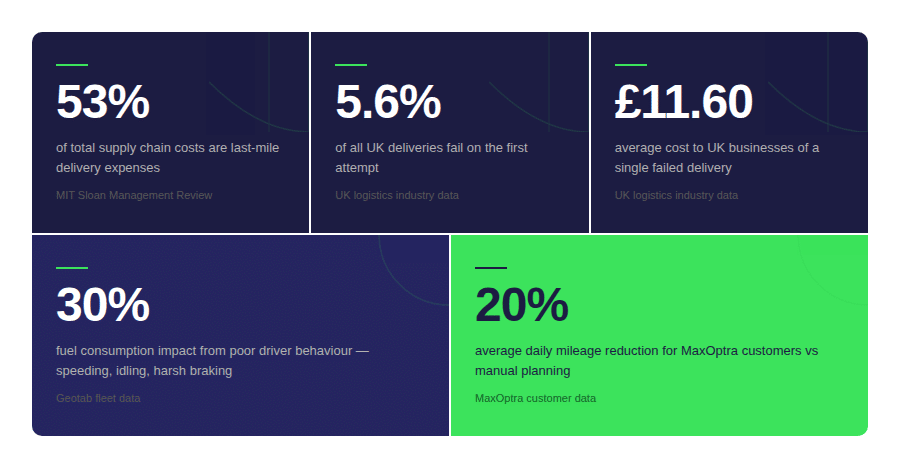
The stakes are real, especially as last-mile delivery expenses can account for up to 53% of total supply chain costs. For food wholesalers, who are already navigating tight margins, perishable stock, and demanding foodservice customers, that figure is impossible to ignore.
The good news is that most of the challenges food wholesalers face are predictable. And predictable problems have solutions.
Here are seven of the most common food wholesale delivery challenges, and what you can do to tackle them.
1. Tight delivery windows that leave no room for error
Food wholesale customers, restaurants, hotels, and caterers don’t just want their deliveries on time. They need them. A kitchen that runs out of ingredients at 8am because a food wholesale delivery didn’t arrive in the expected window faces a serious problem. That pressure flows directly back to you.
Managing multiple tight windows across a large delivery run is genuinely difficult to do manually. Route planning that doesn’t account for traffic, sequencing, or realistic driver capacity will almost always result in missed slots somewhere along the route.
The solution
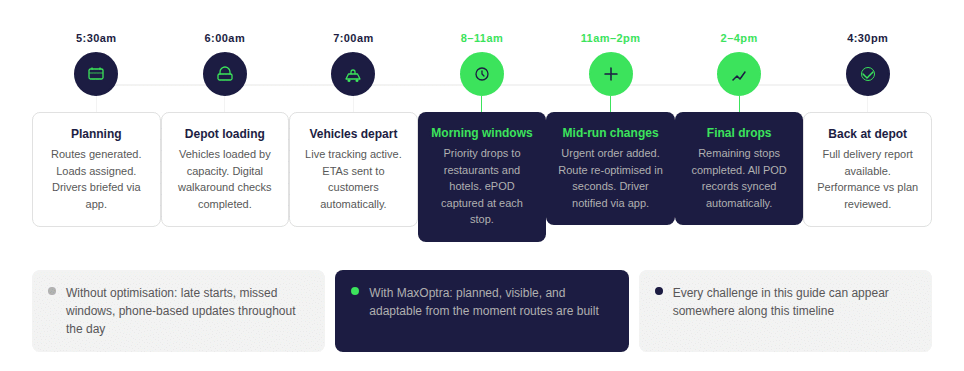
The solution is route optimisation software that factors in customer time windows at the planning stage. Rather than trying to retrofit a route around arbitrary time slots, good software builds the route around the windows from the outset, flagging conflicts before vehicles ever leave the depot. When something changes mid-run, dynamic rerouting means drivers can adapt without missing the next stop. You can read more about how this works in practice in our guide to satisfying same and next-day delivery demand.
2. Routes that are planned on experience rather than data
There’s nothing wrong with an experienced driver knowing their patch. But relying on institutional knowledge to plan routes across a whole fleet is a recipe for inconsistency. What works for one driver on a good day might not work for another, or on a day when roadworks change everything.
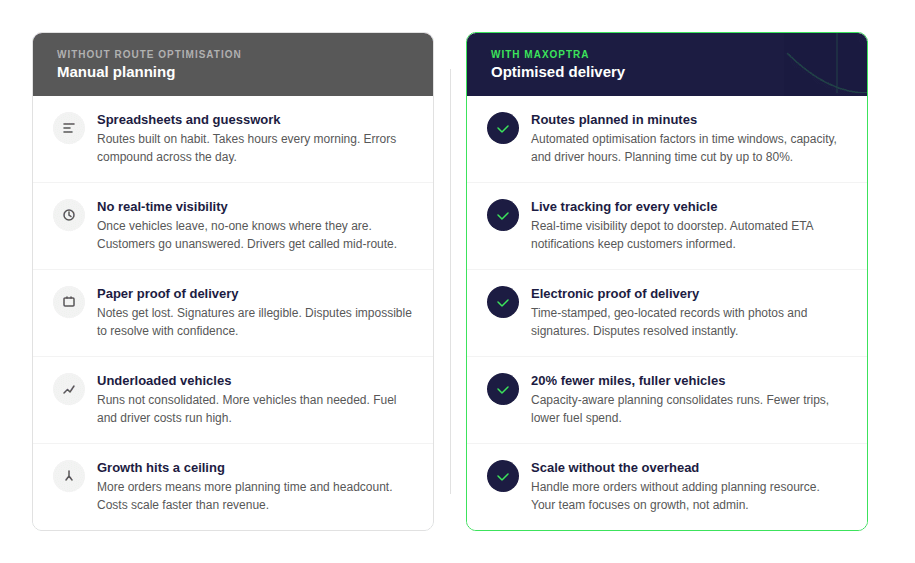
Many food wholesale businesses are still planning routes manually, using spreadsheets or even paper, and then wondering why fuel costs are high and vehicles aren’t back when expected.
Fuel is one of the biggest cost centres in any food wholesale delivery operation. Fleet telematics and route optimisation can cut unnecessary miles and reduce idle time, helping fleets save upward of $10,000 every year on fuel costs alone. Driver behaviour is a significant factor too: habits like speeding, idling, and harsh braking can impact fuel consumption by as much as 30%.
The solution
The solution is automated route optimisation. It considers vehicle capacity, driver hours, road conditions, and delivery windows simultaneously, producing routes that are consistently efficient rather than occasionally good. MaxOptra customers see an average daily mileage reduction of 20% after switching from manual planning, with planning time reduced by up to 80%. Over time, the data generated also gives food wholesale operations genuine insight into where they can improve further.
3. Lack of visibility once vehicles leave the depot
This is one of the most common frustrations we hear from food wholesale businesses. The moment a vehicle pulls out of the yard, visibility disappears. Customers ring to ask where their delivery is. Your office team has no reliable answer. Drivers are called on the phone, which is both a distraction and a safety risk.
This lack of real-time visibility creates stress for everyone, including customers who simply want to know whether they need to send someone to wait at the goods entrance.
5.6% of all UK deliveries fail on the first attempt, and poor visibility is a major contributing factor. When office teams can’t track progress in real time, they can’t intervene early enough when a run is falling behind.
The solution
Live tracking gives your team a real-time view of every vehicle, every stop, and how the day is progressing against the plan. When a customer calls, you can tell them exactly where their food wholesale delivery is, when it will arrive, and whether anything has changed. Automated ETA notifications sent directly to customers via email or SMS take this further, reducing inbound calls and building trust even when things don’t go to plan. You can see a full breakdown of these features on our MaxOptra functionality page.
4. Proof of delivery disputes
Food wholesale is a sector where disputes about deliveries are not uncommon. A customer claims they didn’t receive a delivery. A driver insists it was made. Without evidence, resolving the dispute fairly is almost impossible. And the cost of replacing product that was actually delivered goes straight to your bottom line.
Paper delivery notes get lost, damaged, or signed illegibly. By the time a dispute arises, the paperwork is usually long gone. When disputes lead to unnecessary replacements on top of that, the numbers add up quickly.
The solution
Electronic proof of delivery (ePOD) captures a time-stamped, geo-located record of every food wholesale delivery. Photos, signatures, and notes can all be captured at the door, stored securely, and retrieved instantly when needed. Disputes get resolved quickly, fairly, and with hard evidence. The Food Standards Agency recommends robust record-keeping as part of food business compliance, and ePOD supports that obligation as a useful by-product.
5. Inefficient vehicle utilisation
Running food wholesale delivery routes that don’t make full use of your vehicle capacity is a hidden cost that many businesses don’t quantify. Sending a part-loaded vehicle on a route that could have been combined with another, or running more vehicles than you need because routes haven’t been properly consolidated, adds up over time in fuel, driver hours, and wear on your fleet.
This is especially relevant for food wholesalers who have grown quickly. Routes that made sense when the business was smaller often haven’t kept pace with a larger, more complex customer base.
The solution
Capacity-aware route planning ensures you’re loading vehicles appropriately and not running unnecessary miles. MaxOptra on average reduces vehicles needed by two for every ten in use, and customers only pay for what they use. By optimising around weight, volume, and vehicle type, many food wholesale businesses find they can reduce the number of runs needed, cut fuel costs, and free up driver capacity for growth without adding headcount or vehicles.
6. Driver communication and compliance
Getting information to and from drivers efficiently is harder than it sounds. Route changes, new delivery instructions, access codes, customer notes: all of these need to reach the driver clearly and quickly. If that information is being passed by phone call, WhatsApp message, or a printed sheet at the start of the day, things will be missed.
For food wholesale operations in particular, compliance matters too. Businesses need to ensure drivers are adhering to working time regulations and taking appropriate breaks. The Driver and Vehicle Standards Agency (DVSA) takes working time compliance seriously, and manual monitoring is both time-consuming and easy to get wrong.
The solution
A driver app connected to your routing and scheduling platform means information flows both ways in real time. Drivers receive updated instructions directly to their device. The back office can see when stops are completed, when breaks are taken, and whether the day is running to schedule. It replaces a lot of noise with clear, structured communication. MaxOptra’s driver app also supports digital vehicle walkaround checks, helping food wholesale businesses stay compliant with DVSA requirements without the paperwork.
7. Scaling without proportionally scaling costs
Growth is the goal, but in food wholesale logistics, growth often means adding vehicles, drivers, and planning resource in proportion. The planning function in particular can become a bottleneck as the operation scales. A planner who could manage 10 routes manually struggles to manage 25 with the same tools.
The solution
Route optimisation typically delivers 10 to 15% fuel savings in the first quarter, with some operators reaching 20 to 25% as drivers adapt to optimised routes. That kind of saving, sustained and compounded across a growing food wholesale fleet, is what makes the difference between logistics being a growth enabler or a growth constraint.
The right software grows with you. Route optimisation and fleet management platforms like MaxOptra are designed to handle increasing complexity without a proportional increase in planning time. As this guide to winning back planning hours explores, what takes hours manually can be done in minutes, meaning your planning team’s capacity scales with the business rather than becoming the constraint.
Getting the foundations right
Most of these food wholesale delivery challenges have something in common. They’re not caused by bad intentions or lack of effort. They’re caused by trying to manage a complex, time-sensitive operation without the tools designed for it.
MaxOptra is built specifically for businesses like yours. It brings together route optimisation, live tracking, electronic proof of delivery, and driver communication in a single platform, giving your team the visibility and control to run a more efficient, reliable food wholesale delivery operation.
If you’re experiencing any of these challenges, it’s worth seeing how a purpose-built solution could change things for your business.
Book a demo with the MaxOptra team to see our solution in action.
Food Wholesale Delivery Challenges FAQ
What are the most common food wholesale delivery challenges?
The most common food wholesale delivery challenges include missed time windows, inefficient route planning, lack of real-time visibility, and proof of delivery disputes. Most stem from trying to manage a complex, time-sensitive operation with manual tools that weren’t built for the job.
Why are delivery time windows so critical for food wholesale businesses?
Food wholesale customers such as restaurants and hotels depend on deliveries arriving within specific windows to keep their kitchens running. A missed slot doesn’t just inconvenience the customer – it can cost you the account.
How does route optimisation software help food wholesalers overcome delivery challenges?
Route optimisation software automates the planning process, factoring in time windows, vehicle capacity, driver hours, and road conditions simultaneously. MaxOptra customers typically see a 20% reduction in daily mileage and planning time cut by up to 80%.
What is electronic proof of delivery and why does food wholesale businesses need it?
Electronic proof of delivery (ePOD) captures a time-stamped, geo-located record of each food wholesale delivery, including photos, signatures, and notes. It removes ambiguity from disputes and means issues can be resolved quickly with hard evidence rather than guesswork.
How can food wholesalers reduce the cost of failed deliveries?
With 5.6% of UK deliveries failing on the first attempt, failed deliveries are a significant drain on food wholesale operations. Route optimisation, live tracking, and automated customer notifications all reduce the likelihood of a failed drop before it happens.
How can food wholesale businesses reduce fuel costs across their fleet?
Poor driver behaviour such as speeding, harsh braking, and excessive idling can increase fuel consumption by as much as 30%. Route optimisation reduces unnecessary mileage across your food wholesale fleet, while driver apps give managers the visibility to coach better driving habits.
Can route optimisation software scale with a growing food wholesale operation?
Purpose-built platforms like MaxOptra are designed to handle increasing food wholesale delivery complexity without a proportional increase in planning time or headcount. As your operation grows, the software grows with it rather than becoming the bottleneck.
How quickly can a food wholesale business see results from route optimisation?
Most MaxOptra customers see a return on investment from the outset through immediate fuel savings, reduced planning time, and fewer missed delivery windows. The platform integrates with existing telematics, ERP, and WMS systems via an open API, so it works alongside your current setup from day one.
Maxoptra System
© MaxOptra, 2023. Privacy Policy and Cookies